

I’m about to share 5 steps to launch your digital product that will finally get you from “someday I’ll do this” to “holy crap, I actually did it!”
There you are, scrolling through Instagram, watching everyone else announce their course launches and celebrate their Stripe notifications while you’re still stuck in planning mode. Another Pinterest board saved. Another YouTube tutorial bookmarked. Another month gone by without actually putting anything out into the world.
I’ve been there. Trapped in what I like to call “preparation disguised as procrastination.” Convinced that I needed one more thing figured out before I was ready. Spoiler: that one more thing turned into seventeen more things, and I wasted six months I’ll never get back.
Here’s the truth nobody’s telling you about launching digital products: you don’t need to have it all figured out. You need a framework that forces you to take action. That’s exactly what these 5 steps to launch your digital product will give you. No fluff. No overwhelm. Just a clear path from idea to income.
Before we dive into the framework, let’s talk about what’s really stopping you. Because I promise, it’s not what you think.
It’s not that you don’t have good ideas. You have too many. It’s not that you’re not smart enough. You’re probably overthinking it. And it’s definitely not that you need another course on course creation.
Most first-time digital product launches fail because people skip steps, get stuck in perfectionism, or try to wing it without a real plan. They either spend three months building something nobody wants, or they never launch at all because the whole process feels like trying to assemble IKEA furniture without instructions… in the dark… while someone’s yelling at you.
The framework I’m about to share fixes that. It breaks down the entire product launch process into five clear phases, so you always know exactly what you should be working on and when.
Let’s get into it.
Every successful digital product starts here, and rushing this step is how people end up with products that collect dust instead of dollars.
Your mission in this phase is threefold: choose your product idea, define your offer, and map out your launch timeline.
Choose Your Product Idea
This is where most people spiral into analysis paralysis, so let’s keep it simple. The best digital product ideas solve a specific problem for a specific person. That’s it. Not a revolutionary, never-been-done-before concept. Just a clear solution to a real pain point.
Ask yourself these questions:
What problem have you already solved for yourself? What do people constantly ask you for help with? What would you have paid money for when you were starting out?
The idea that checks the most boxes wins. Don’t overthink it. Your first product doesn’t need to be your magnum opus. It needs to exist.
Define Your Offer
Once you have your idea, get crystal clear on what you’re actually selling. Not just the format (template, course, guide), but the transformation. What does your buyer’s life look like before they purchase? What does it look like after?
Write this down in one sentence: “I help [specific person] go from [current struggle] to [desired result] using [your solution].”
This becomes the foundation for everything else, so take ten minutes and nail it.
Map Out Your Launch Timeline
Here’s where having a deadline becomes your best friend. Pick a launch date and work backwards. If you give yourself six months, you’ll take six months. Give yourself two weeks, and suddenly you’re making decisions at lightning speed.
I recommend setting a launch date 2-4 weeks out for your first digital product. Tight enough to create urgency, but realistic enough that you won’t burn out.
Alright, planning is done. Now we actually build your digital product.
This phase has three parts: build your digital product, use AI Product Builder prompts to speed things up, and create your offer package.
Build Your Digital Product
Whatever format you chose in step one, it’s time to create it. Templates? Open up Canva or Google Sheets and start building. Mini course? Map out your modules and record. PDF guide? Start writing.
The key here is momentum over perfection. Your first version doesn’t need to be polished. It needs to be done. You can always update and improve based on customer feedback, but you can’t improve something that doesn’t exist.
Set a timer. Give yourself focused work blocks. And resist the urge to tweak the font for the fourteenth time when you should be adding actual content.
Use AI to Speed Up Creation
This is where working smarter beats working harder. AI tools can help you brainstorm content, write product descriptions, create outlines, and handle the tedious parts of product creation that usually slow people down.
Instead of staring at a blank screen wondering what to write next, you can use AI prompts to generate ideas and draft content that you then refine with your expertise and voice. It cuts creation time dramatically without sacrificing quality.
Create Your Offer
Your offer is more than just the product itself. Think about what would make this a no-brainer purchase. Any bonuses that complement the main product? A quick-start guide? Templates that make implementation easier?
You don’t need to go overboard here. Sometimes one well-designed bonus is more valuable than five mediocre ones. Focus on what helps your buyer get results faster.
You’ve got a product. Now people need a place to buy it. This step is where a lot of aspiring creators freeze up because sales pages feel intimidating. But they don’t have to be.
Customize Your Sales Page Template
Unless you’re a copywriter, start with a template. Seriously. There are proven structures for sales pages that work. You don’t need to reinvent the wheel.
Your sales page needs to answer these questions in order:
Who is this for? What problem does it solve? What’s included? What results can they expect? How much does it cost? How do they get it?
That’s the skeleton. Everything else is just adding personality and proof.
Write Compelling Copy
Here’s the thing about sales copy: it’s not about being clever. It’s about being clear. Write like you’re explaining your product to a friend who asked what you’re working on. Use their language. Address their specific concerns. Paint a picture of what’s possible.
If writing copy makes you want to throw your laptop out the window, this is another area where AI tools can be incredibly helpful. Use prompts to draft your headlines, bullet points, and product descriptions, then edit to sound like you.
Set Up Checkout and Delivery
Pick a platform to sell through. Gumroad, Stan Store, Podia, Teachable… there are tons of options, and most have free plans to start. Connect your payment processor, upload your product files, and set up automatic delivery so buyers get instant access.
Test the entire purchase flow yourself before launch. Nothing kills momentum like a broken checkout link.
Even if your email list is tiny, this step matters. Email is still one of the highest-converting channels for digital product sales. Your subscribers already know you, which means they’re way more likely to buy than cold traffic.
Set Up Your Launch Emails
You don’t need a complicated 47-email funnel. For your first launch, plan for about 10 emails spread across your launch window. Here’s a simple structure that works:
A few emails before launch to build anticipation (what you’re creating and why). Launch day announcement (it’s live, here’s what it is, here’s the link). Mid-launch value emails (tips related to your product topic, case studies, behind-the-scenes). Final day urgency (last chance, what they’ll miss if they don’t act).
Schedule Your Email Campaign
Write your emails in advance and schedule them to send automatically. This way, you’re not scrambling to write copy at 11pm on launch day. You can focus on engaging with your audience instead.
Most email platforms have simple scheduling features. Set it up, test that emails are actually sending, and then let automation do its job.
Prepare Your List
Before launch day, give your list a heads up that something is coming. This primes them to look for your emails and builds anticipation. Even a simple “Something exciting is coming next week” email can boost your open rates when launch day arrives.
This is the moment everything has been building toward. Your product exists. Your sales page is live. Your emails are ready. Now you actually launch your digital product and start selling.
Execute Your Launch Plan
Launch day is about visibility and connection. Post on your social platforms. Send your launch emails. Show up in communities where your audience hangs out. Talk about what you created and why it matters.
You’re not being pushy. You’re offering a solution to people who need it. There’s a difference.
Have a simple day-by-day plan for your launch week. When will you post? What platforms? What angles? Map it out so you’re not making decisions on the fly when you should be engaging with potential buyers.
Go Live With Your Product
Flip the switch. Make your sales page public. Send that first email. Hit publish on your launch post.
The first time you do this is terrifying. Your brain will try to convince you to wait one more day, tweak one more thing, delay just a little longer. Ignore it. Done is better than perfect, and real feedback from real customers is worth more than another week of hypothetical improvements.
Make Your First Sales
When those first notifications come in, that feeling is unmatched. Someone saw what you created, decided it was valuable, and paid you for it. That’s validation that all the planning and creating was worth it.
Even if your launch starts slow, keep showing up. Answer questions. Share testimonials as they come in. Address objections. Most sales don’t happen in the first hour. They happen over your launch window as people move from “maybe” to “yes.”
Let’s recap these 5 steps to launch your digital product:
Step 1: Idea and Planning means choosing your product idea, defining your offer, and mapping your timeline. This is your foundation.
Step 2: Product and Creation involves actually building the thing, using AI tools to speed up the process, and packaging your complete offer.
Step 3: Sales Page Setup covers customizing your page template, writing compelling copy, and setting up checkout and delivery.
Step 4: Email Sequence includes writing your launch emails, scheduling your campaign, and warming up your list.
Step 5: Launch and Sell is executing your launch plan, going live, and making those first sales.
Five steps. That’s the entire framework. No mystery. No confusion. Just a clear path from idea to income.
At this point, you have the framework. You know the steps. The question now is whether you’ll actually use it.
Because here’s what I’ve learned after helping countless creators launch their first products: the biggest obstacle isn’t lack of knowledge. It’s lack of action. It’s staying stuck in learning mode because taking action feels scary.
Your first launch won’t be perfect. Mine definitely wasn’t. But it will teach you more than another six months of “getting ready” ever could. It will show you what your audience actually responds to. It will give you momentum. And it will prove to yourself that you can do this.
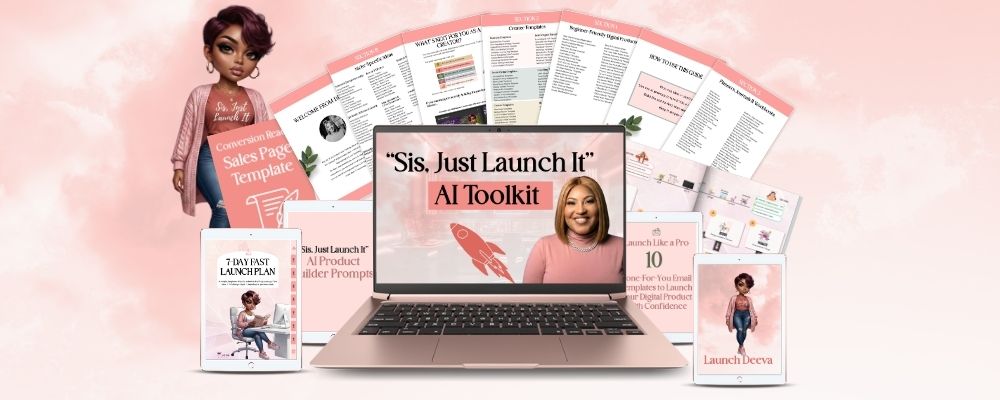
If you’re ready to stop planning and start launching, the Sis, Just Launch It AI Toolkit was built exactly for this. It includes AI Product Builder prompts to help you create your product faster, done-for-you email templates for your launch sequence, sales page frameworks that convert, and everything else you need to move through these five steps without getting stuck.
Think of it as your launch co-pilot. The toolkit handles the pieces that usually slow people down, so you can focus on what matters: getting your product into the world and making your first sales.
Your launch starts with a decision. Which step are you tackling today?

Digital Product AI Creator & Mentor