

Most first-time creators never actually launch a digital product.
Not because they don’t have good ideas. Not because they lack the skills. But because they get stuck in a trap that feels productive, but leads absolutely nowhere.
I see it constantly. Someone gets excited about creating a digital product, maybe an ebook, a template, a mini-course. They start planning. They research. They watch tutorials. They create mood boards and outline structures and obsess over every tiny detail.
And then… nothing. Weeks turn into months. The initial excitement fades. They convince themselves the timing isn’t right, the idea isn’t good enough, or they need to learn “just one more thing” before they’re ready.
Sound familiar?
Listen, I’ve been that person. I spent four months “getting ready” to launch my first digital product. Four. Entire. Months. You know what I was doing during that time? Watching other creators launch and make money while I perfected a landing page that nobody ever saw.
The problem isn’t that launching a digital product as a beginner is actually hard. The problem is that we make it unnecessarily complicated, then use that complexity as an excuse to never start.
So let’s talk about why this keeps happening and more importantly, how to break the cycle and actually get your product out into the world.
It’s not what you think.
Most people assume the barrier to launching a digital product is technical knowledge. “I don’t know how to set up a sales page.” “I’m not good with design.” “I have no idea how payment systems work.”
But here’s what I’ve learned from watching hundreds of creators (and from my own embarrassing four-month delay): the real killer isn’t lack of knowledge. It’s the three deadly Ps.
Perfectionism. You convince yourself your product needs to be comprehensive, professional-looking, and absolutely flawless before you can launch. Spoiler: it doesn’t.
Paralysis. You have too many options and can’t decide which product to create first, what price point to choose, which platform to use, or what format makes sense. So you research endlessly instead of choosing.
Procrastination disguised as preparation. This one’s sneaky. You feel busy and productive because you’re always “working on” your product. Tweaking the outline, redesigning the cover, rewriting the sales copy for the fifteenth time. But you’re not actually moving toward launch. You’re just spinning.
These three things create a vicious cycle. You overthink because you want it to be perfect. Perfectionism leads to too many options and decision paralysis. Paralysis makes you procrastinate by pretending you’re still “preparing.” And round and round you go.
I know because I did exactly this. I redesigned my first product’s workbook seven times. SEVEN. Each time, I convinced myself it needed to be “more creative” or “more comprehensive.” What I was really doing? Avoiding the scary part… putting something imperfect out there and seeing if anyone would buy it.
Let’s get really honest for a second.
These are the lies I told myself (and the lies I hear from creators all the time) that keep us from ever launching:
“I need a bigger audience first.” No, you don’t. I launched my first product to 63 email subscribers. Sixty-three. And I made sales. You don’t need thousands of followers. You need a handful of people who have the problem you’re solving.
“My idea isn’t unique enough.” Good! Unique ideas are often hard to sell because nobody knows they need them. Your job isn’t to invent something totally original. It’s to solve a problem in YOUR voice, with YOUR perspective, for YOUR specific audience.
“I’m not expert enough.” You don’t have to be the world’s leading authority. You just need to be a few steps ahead of the people you’re helping. If you’ve solved a problem for yourself, you’re qualified to teach others how to do it.
“I need more time to make it really good.” Translation. I’m scared to put something out there that isn’t perfect. But here’s the truth… your “really good” version in three months won’t be any more valuable than your “good enough” version today. And your “good enough” version can start making you money and giving you feedback right now.
“Nobody will buy from me.” This is just fear talking. If you’re solving a real problem for a specific person, and you communicate that clearly, people will buy. Maybe not hundreds at first. But some will. And that’s all you need to start.
Every single one of these thoughts kept me stuck. And every single one was proven wrong the moment I actually launched the damn thing.
Okay, so if perfection doesn’t matter and you don’t need to be an expert, what DOES matter?
Let me break it down based on what I learned from my messy first launch and the fifteen products I’ve created since then.
Clarity beats comprehensiveness. Your first product doesn’t need to cover everything about your topic. It needs to solve ONE specific problem really well. The clearer and more focused your product is, the easier it is to create and the easier it is to sell.
My mistake was trying to make my first product solve every possible digital product designing problem. When I stripped it down to just “How to get clear on your first digital product in 30 minutes,” suddenly it became simple to create and simple to explain.
Speed beats perfection. A launched product that’s 80% perfect will always be more valuable than a 100% perfect product that never sees the light of day. Why? Because the launched product makes money, gets feedback, and teaches you what your audience actually wants. The perfect product just sits on your hard drive.
Solving a real problem beats having a big audience. If ten people have a painful problem and you solve it, you’ll make sales even with a tiny audience.
If you have 10,000 followers but your product doesn’t solve a specific painful problem, you’ll struggle to make sales. Problem-solution fit matters more than audience size.
Done beats planned. I’ve said this before but it bears repeating. You will learn more from launching one imperfect product than from planning five perfect ones. The real education happens when you put something out there and see how people respond.
Alright, enough about what doesn’t work. Let’s talk about what does.
If you’re a first-time creator who wants to actually launch a digital product (not just talk about it), here’s the strategy that works:
Set a hard deadline. Not “sometime next month.” Not “when it’s ready.” Pick a date, ideally within 7 days and commit to it publicly.
Tell someone. Post about it. Make it real. Deadlines force you to prioritize and cut through the perfectionism. You can come over to my Free community She Builds With AI if you need to have some accountability.
Start with a micro-product. Your first digital product should be small. A template. A checklist. A short guide. Something you can create in a few hours, not a few months. Why? Because finishing something small gives you momentum and proves you can actually do this.
Choose your format based on speed, not impressiveness. PDF? Google Sheet? Canva template? Pick whatever you can create fastest with the skills you already have. Don’t learn a new platform or software for your first product. Use what you know.
Solve one problem for one person. Get hyper-specific. Not “content planning for entrepreneurs.” Instead, “30-day content calendar for busy coaches who post on Instagram three times a week.” The more specific, the easier to create and sell.
Launch to your existing audience, however small. You don’t need to wait until you have more followers. The people who are already following you are following you because they’re interested in what you have to say. Start there.
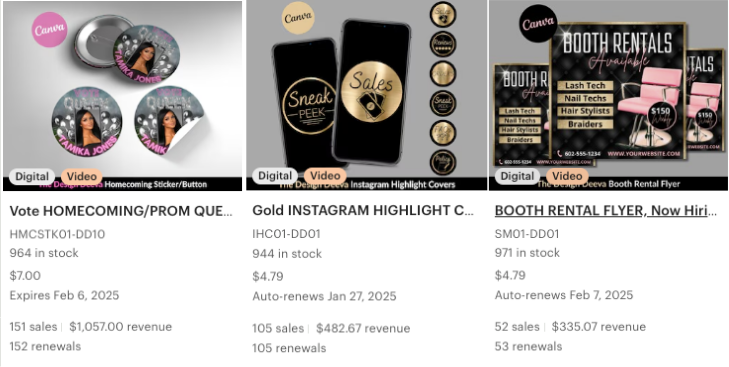
When I finally stopped overthinking and followed this exact strategy, I launched my first Canva template in like a few hours. A few hours versus the four months I’d spent “preparing” before that. And you know what? The few hour template made more money than I would’ve made with the perfect version because it actually existed.
Here’s a concept that changed everything for me: the Minimum Viable Launch.
You don’t need a fancy website, elaborate sales funnel, email sequence, webinar, or any of the complicated stuff you see other creators doing. You need four things:
That’s it. Seriously.
One of my launches looked like this: a Skool community, a Google Doc as a sales page, and Thrivecart to collect the payment. No fancy graphics. No elaborate launch strategy. Just “Hey, I made this thing that helps with building your digital product business, here’s why it’s useful, click here to buy it.”
And it worked.
Could I have made it fancier? Sure. Would fancy have made it sell better? Probably not. Would fancy have taken me another month to set up? Absolutely.
The Minimum Viable Launch gets you 80% of the results with 20% of the effort. And as a beginner, that’s exactly what you need. You need to learn by doing, not planning.
Let’s talk about the elephant in the room… you’re going to be scared.
Scared to charge money. Scared nobody will buy. Scared people will judge your imperfect product. Scared to look foolish. Scared to fail.
I get it. I’ve felt all of it.
The night before my first launch, I seriously considered deleting everything and pretending it never happened. The fear was real.
But here’s what I learned from that experience. The fear doesn’t go away by waiting. It doesn’t disappear when you make your product “better” or when you have “more followers” or when you feel “more ready.”
The fear goes away by launching anyway.
Every time you do the scary thing, you prove to yourself that you can handle it. The second launch is less scary than the first. The third is less scary than the second. Not because you’re suddenly confident or fearless, but because you have evidence that you can survive the fear.
When fear shows up (and it will), here’s what to remember:
Nobody is paying as much attention as you think. Most people are too busy worrying about their own stuff to scrutinize yours.
Your first product doesn’t define you. If it flops, you create another one. If it’s imperfect, you improve it. Nothing is permanent.
Imperfect action beats perfect inaction every single time. Every successful creator you admire launched something imperfect first.
You’re allowed to be a beginner. Nobody expects your first product to be a masterpiece. Give yourself permission to suck at this and learn as you go.
Look, I’m not going to pretend like launching is easy. Even with the right strategy, there are still a million small decisions to make and things to figure out.
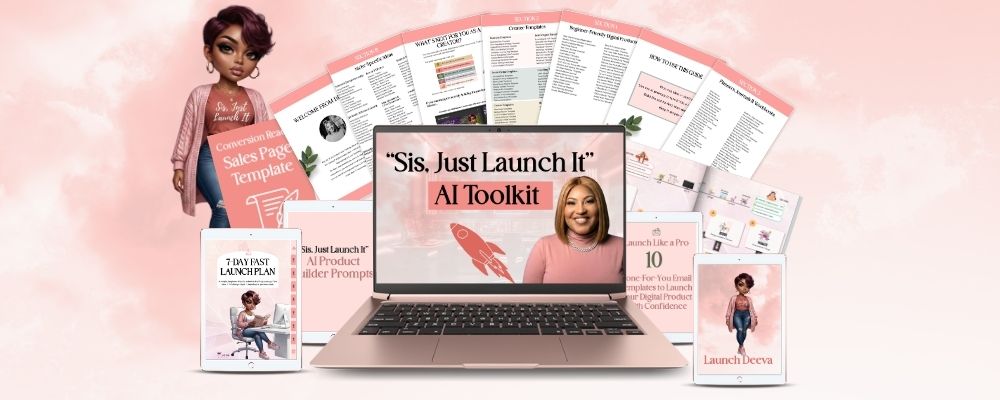
That’s exactly why I created the Sis, Just Launch It AI Toolkit.
Because I remember being frozen at my laptop, staring at a blank sales page, not knowing what to write. I remember second-guessing my product idea seventeen times. I remember feeling overwhelmed by all the little pieces that go into a launch.
The toolkit is basically everything I wish I’d had when I was launching my first product. AI prompts that help you brainstorm ideas, write your sales copy, create your launch content, price your product, handle objections, all of it. It’s like having someone walk you through each step so you’re never stuck wondering “what do I do next?”
It won’t do the work for you (you still have to create the actual product), but it removes the decision fatigue and blank-page paralysis that keeps most beginners stuck.
If you’re tired of overthinking and ready to actually launch, it might be exactly what you need to get unstuck.
Here’s what I want you to understand. Your first digital product will not be perfect.
It might be a little rough around the edges. You might price it wrong. Your sales page might be awkward. You’ll probably forget to mention something important or realize after launch that you could’ve explained things better.
And that’s completely, totally, 100% okay.
Because the point of your first launch isn’t perfection. The point is momentum.
You’re proving to yourself that you can finish something. You’re learning what your audience actually wants and how they respond. You’re building the muscle of creating and selling. You’re making your first dollar from something you built.
Every product after that gets easier. Every launch gets smoother. Every version gets better.
But you have to start somewhere. And starting imperfectly is infinitely better than never starting at all.
My first product made $81. Not life-changing money, but it changed my life anyway because it proved that people would pay for something I created. That single launch gave me the confidence to create product number two, then three, then eventually build a five-figure digital product business.
But none of that would’ve happened if I’d stayed stuck in planning mode, waiting to feel ready.
So here’s where we are.
You can spend the next three months researching how to launch a digital product as a beginner. You can watch more tutorials, read more blog posts, perfect your idea, and convince yourself you need “just a little more time” to prepare.
Or you can spend the next 7 days actually creating and launching something real.
One path feels safer. The other path gets you results.
Most first-time creators never launch because they pick the first path. They stay comfortable in planning mode, where there’s no risk of failure or judgment or imperfection.
But you’re not most creators. You’re reading this post because something in you wants to actually do this thing. You’re tired of waiting and watching and wishing.
So do it.
Pick a simple product idea. Set a deadline. Build the minimum viable version. Launch it to whoever’s already paying attention to you. Learn from what happens. Improve and create the next one.
That’s how every single successful creator you admire started. Not with a perfect first product, but with the courage to launch an imperfect one.
Your first digital product is waiting to be created. The question is: are you going to keep planning, or are you finally going to launch?
The **Sis, Just Launch It AI Toolkit** is here when you’re ready to stop overthinking and start building. But either way, please—for the love of all things creative—set a deadline and ship something.
The world needs what you’re going to create. Even if it’s not perfect.
Especially if it’s not perfect.

Digital Product AI Creator & Mentor