

Can I let you in on a little secret about selling digital products?
The difference between a product that sits there collecting digital dust and one that sells out isn’t always about quality.
It’s about understanding the psychology of selling digital products. Knowing exactly what makes someone go from “hmm, interesting” to frantically entering their credit card info.
People don’t buy digital products because they’re logical purchases. They buy them because something in their brain flipped a switch. And if you can figure out what flips that switch, you can sell pretty much anything.
I learned this the hard way when I launched my first two digital products in the same month. Same audience. Same price point. Same amount of promotion. One made $4,000 in the 2 hours. The other? Forty-seven dollars total.
Same creator, wildly different results. The only difference was that I accidentally stumbled onto psychological triggers with the first product that I completely missed with the second one.
So let me pull back the curtain on the psychology of selling digital products and talk about what actually makes people click that buy button, even when they told themselves they weren’t going to spend any more money this month.
Let’s start with the uncomfortable truth… nobody wakes up thinking, “You know what I need today? A PDF workbook.”
People don’t buy digital products. They buy the future version of themselves.
Think about the last digital product you bought. Maybe it was a course, a template, a guide, whatever. You didn’t buy it because you wanted files on your computer. You bought it because you believed it would transform you from the person struggling with a problem into the person who has that problem solved.
That’s the psychology of selling digital products in a nutshell. You’re selling transformation, not information.
When my first product flopped, I positioned it as “50 Social Media Templates.” Cool, great, very descriptive. But when someone sees that, their brain goes, “Okay, so what?” There’s no emotion. No transformation. Just… templates.
When I repositioned it as “The Content System That Frees Up 10 Hours a Week (So You Can Actually Run Your Business Instead of Feeding the Algorithm)”(same exact templates, by the way), suddenly people were interested. Because now they weren’t buying templates. They were buying their time back.
Your job isn’t to convince people they need information. It’s to help them see the version of themselves that exists on the other side of buying your product.
After selling digital products for almost several decades, and probably overthinking every single launch, I’ve noticed six psychological triggers that consistently get people to buy. And here’s the thing, they work because they’re tapping into real human behavior, not manipulation tactics.
People are more motivated to avoid pain than to gain pleasure. It’s just how our brains are wired.
This is why “Stop Wasting 15 Hours a Week on Content Creation” hits harder than “Create Content More Efficiently.” Both say basically the same thing, but one speaks directly to the pain someone is actively experiencing right now.
When you’re selling digital products, lead with the pain point. What is your person lying awake at night worrying about? What frustration made them search for a solution in the first place? What’s the thing they’re so tired of dealing with that they’d gladly pay to make it stop?
I tested this with two versions of the same sales page. Version A focused on all the cool features and benefits. Version B opened with “Tired of posting daily on social media just to hear crickets?” and described the exact frustration my audience felt. Version B converted at almost double the rate.
Your potential customers are already in pain. Your product is the pain reliever. Make that connection crystal clear.
We are herd animals. We like knowing other people have tried something and it worked.
This is why testimonials aren’t just nice to have, they’re essential to the psychology of selling digital products. When someone sees that real people got real results, their brain relaxes. The risk feels smaller. The decision feels safer.
But here’s what most people get wrong about social proof, generic praise doesn’t cut it. “This product is great!” tells me nothing. “I used this template last Tuesday and booked three new clients by Friday” tells me everything.
Specific results. Specific transformations. Specific people.
Even if you’re launching your first product and don’t have testimonials yet, you can use other forms of social proof.
How many people you’ve helped with this method before you packaged it as a product, results you’ve personally gotten, or even borrowing credibility from where you learned the information.
When I launched my coaching program with zero testimonials, I shared that I’d personally used this exact system to grow my business to $5k/months. That was social proof enough to get my first buyers, who then gave me actual testimonials for future launches.
Here’s where things get a little controversial, so stay with me.
Scarcity works. Our brains hate missing out on opportunities. When something might not be available later, we suddenly want it way more than we did five minutes ago.
BUT, and this is a big BUT. Fake scarcity ain’t the business, and people can smell B.S. a mile away. “Only 3 spots left!” when you have infinite digital copies? Come on!
Real scarcity, though? That’s powerful and ethical.
Real scarcity looks like:
I run launches & cohorts regularly, where the price is lower at the beginning. And I include bonuses and extra stuff. But, after launch week, the price goes up and the bonuses aren’t available anymore.
This isn’t fake. It’s real AF. I genuinely give more attention to launch buyers and those bonuses take work to deliver. The scarcity is real, and people respond to it.
Create genuine scarcity around your launches & promos. Just don’t lie about it.
People want to buy from someone who clearly knows what they’re talking about.
But here’s the good news… you don’t have to be the world’s leading expert. You just have to know more than the person you’re selling to and be able to prove it.
The psychology of selling digital products relies heavily on positioning yourself as the guide who’s already walked the path your customer is trying to walk.
You’ve solved the problem they’re struggling with. You’ve made the mistakes they’re about to make. You’ve figured out the shortcut.
This is why sharing your journey is so powerful. When I talk about how I wasted six months overthinking my first product launch, I’m building authority. Not because I’m perfect, but because I’ve been there, done that, and learned from it.
Authority comes from:
You build authority every time you show up and share something valuable. Your digital product should be the natural next step for people who already see you as the person who can help them.
We live in an Amazon Prime world. We want, what we want, and we want it immediately.
This is actually one of the biggest advantages of digital products… instant delivery. The second someone buys, they can start implementing. There’s no waiting, no shipping, no delay between decision and transformation.
Play this up in your sales copy. “Start using this today.” “Instant access.” “Download immediately.” These phrases tap into our desire for immediate results.
But don’t just promise instant access, promise instant wins. What’s the quick win someone can get in the first 30 minutes of using your product? Lead with that.
When I sell my templates, I don’t just say “instant download.” I say “instant download! Spend 10 minutes customizing these templates and you’ll have a product ready to deliver.” That’s instant gratification. That’s what gets people to click buy.
If I give you something valuable for free, you feel slightly obligated to return the favor. That’s just human nature.
This is the entire foundation of content marketing and why lead magnets work so damn well. When you consistently give away valuable free content, people start to think, “If this is what she gives away for free, imagine what the paid stuff is like.”
I’ve given away thousands of dollars worth of free templates, guides, and advice. And you know what? It makes selling easier, not harder. Because by the time someone sees my paid product, they’ve already gotten results from my free stuff. They trust me. They want more.
The psychology here is simple… we like to buy from people who’ve already helped us.
Give generously. Share your best stuff. Then when you launch a product, you’re not asking strangers to trust you, you’re offering your biggest fans a chance to go deeper.
Now that we know what works, let’s talk about what absolutely tanks sales because I’ve made all these mistakes and watched my conversion rates fall drastically.
Mistake #1: Focusing on features instead of transformation
Nobody cares that your workbook has 47 pages. They care that those 47 pages will help them finally figure out their content strategy without spending hours staring at a blank screen.
Features tell. Transformation sells.
Mistake #2: Not addressing objections
Your potential buyer has concerns swirling in their head… “Will this actually work for me? Do I have time for this? Is it worth the money? What if I buy it and never use it?”
If you don’t address these objections in your sales copy, they become reasons not to buy. The psychology of selling digital products requires you to anticipate doubts and dissolve them before they become deal-breakers.
Mistake #3: Being vague about what’s included
Mystery might work for novels, but it kills sales pages. Tell people exactly what they’re getting. The more specific you are, the more valuable it feels.
Instead of “templates and resources,” say “12 plug-and-play Instagram caption templates, 4 customizable Canva graphics, and a content planning spreadsheet pre-loaded with 30 post ideas.”
See the difference?
Mistake #4: Not having a clear, compelling call-to-action
If your CTA is “click here to learn more,” you’re leaving money on the table. Your call-to-action should remind people of the transformation and remove friction.
“Get instant access to the Content System” beats “Learn more” every single time.
Understanding the psychology of selling digital products means understanding the emotional rollercoaster your buyer goes through before they click that button.
Stage 1: Problem Awareness They realize they have a problem. It’s frustrating them. They need a solution.
Stage 2: Solution Research They start looking for answers. They’re comparing options, reading reviews, consuming free content.
Stage 3: Decision Anxiety They’ve found your product and they’re interested, but now the doubt creeps in. Will it work for them? Is it worth it? What if they fail?
Stage 4: The Tipping Point Something tips them over the edge… a testimonial that resonates, a bonus that seals the deal, a moment of clarity where they realize the cost of NOT solving this problem.
Stage 5: Post-Purchase Validation They bought it! Now they need reassurance they made the right choice. This is where your onboarding and first touchpoint matter.
Your sales copy should guide people through all these stages. Address the problem, present the solution, dissolve the anxiety, create the tipping point, and validate the decision.
Okay, enough theory. Let’s talk about how I use all this psychological knowledge when I’m actually creating and selling digital products.
When I sit down to write sales copy, I literally map out the psychological triggers I want to hit. To do this you must know your ideal customer avatar.
I ask myself:
Then I structure my sales page to hit these points naturally, without feeling manipulative or salesy.
For example, I recently taught a small group my exact process for running Facebook ads on a shoestring budget—we’re talking $5-10 a day, not some massive ad spend. Here’s how I mapped in the psychology:
Pain-Relief: Opened with the frustration of posting consistently but getting zero sales, the anxiety of watching other people’s launches blow up while yours barely gets noticed
Social Proof: Shared real results from my students. Sarah landed three sales within 5 days of running her first ad, Theresa got 126 email subscribers in a week spending less than $30, Jennifer made her first sale on day 7 after months of crickets
Scarcity: Live training with Q&A access for one week only, plus my personal ad templates that I don’t share publicly
Authority: Walked them through the exact ad campaigns I’ve run that generated hundreds of leads without burning through my budget, and I did it with them. And we all shared our numbers at the end.
Instant Gratification: Promised they could have their first ad running by the end of our session. And they did
Reciprocity: Had already given them a free lead magnet template the week before, so they trusted I wasn’t just trying to sell them something
Result? Every single person in that training launched their first ad within the week. Most saw leads hit their email list within the first 24 hours of the ad running. A few even made sales before the training was over.
Not because I’m some advertising genius, but because I understood what makes people take action and structured my offer around those psychological principles.
This is exactly the kind of strategic thinking you need when you’re launching digital products and honestly, it’s where most people get stuck.
You know your product is valuable, you understand these psychological triggers, but translating all of that into sales copy that actually converts? That’s a whole different skill set.
That’s exactly why I created the Sis, Just Launch It AI Toolkit. It’s packed with prompts that help you write conversion-focused sales copy using these exact psychological principles without staring at a blank screen for hours trying to figure out how to “sound convincing.”
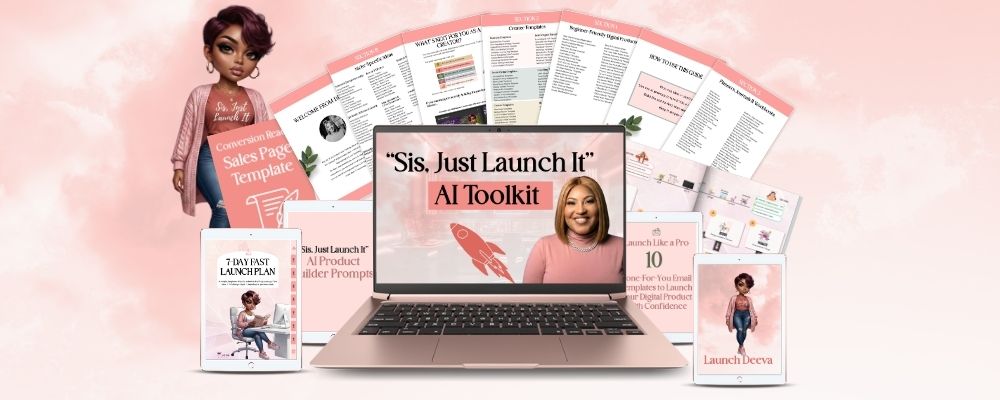
You get prompts for crafting compelling hooks, building social proof sections, creating urgency that doesn’t feel manipulative, and positioning your offer so it practically sells itself.
Think of it as your sales psychology translator, taking everything you know about what makes people buy and turning it into actual words on your sales page.
Before we wrap this up, let’s address the elephant in the room.
Is it manipulative to use psychological triggers in your sales process?
Here’s my take on it… it depends on your intentions.
If you’re using psychology to sell something that genuinely helps people solve a real problem, you’re not manipulating, you’re communicating effectively. You’re helping people make a decision that will improve their lives.
If you’re using psychology to trick people into buying something that won’t actually help them, yeah, that’s fraud, and unethical as hell.
The psychology of selling digital products is a tool. Like any tool, it can be used well or misused. The key is to always start from a place of genuine service. Create products that actually deliver on their promises. Use psychological triggers to help the right people recognize that your solution is right for them.
I sleep well at night because I know my products genuinely help people. I know the heart and thought that I put into creating each one. The psychological principles I use aren’t about manipulation, they’re about clarity. I’m making it easier for my ideal customers aka my peeps to see that I have what they need, and I want them to win with the least amount of struggle.
That’s the difference.
Alright, let’s make this actionable. Next time you’re writing sales copy for a digital product, run through this checklist:
✓ Pain-Relief: Have I clearly articulated the specific pain my product relieves?
✓ Social Proof: Do I have testimonials, case studies, or personal results that show this works?
✓ Scarcity: Is there real, ethical scarcity I can incorporate?
✓ Authority: Have I demonstrated why I’m qualified to solve this problem?
✓ Instant Gratification: Have I promised a quick win people can achieve immediately?
✓ Reciprocity: What have I already given this audience for free that builds goodwill?
✓ Transformation: Am I selling the transformation, not just the information?
✓ Objections: Have I addressed the main concerns someone might have?
✓ Specificity: Am I being specific about what’s included and what results are possible?
✓ CTA: Is my call-to-action clear and compelling?
If you can check all these boxes, you’ve got a psychologically optimized sales page that’s going to convert way better than something that just lists features and hopes for the best.
The psychology of selling digital products isn’t about tricks or hacks. It’s about understanding human behavior and structuring your offers in a way that makes the buying decision feel natural, not forced.
People want to solve their problems. They want transformation. They want to feel confident in their purchase decisions. Your job is to make all of that as clear and easy as possible.
When you understand what makes people click “Buy Now,” selling becomes less about convincing and more about connecting. You’re not pushing people toward a sale, you’re guiding them toward a solution they’re already looking for.
The creators who consistently sell digital products aren’t necessarily the ones with the biggest audiences or the fanciest designs. They’re the ones who understand what their audience needs and know how to communicate that in a way that resonates psychologically.
Ready to apply these psychological principles to your own digital products and actually start making sales? The Sis, Just Launch It AI Toolkit includes everything you need to translate these concepts into real sales copy, positioning strategies, and launch content that converts. No more guessing what to say or how to say it. Just proven psychological frameworks customized for your specific offer.
Now go forth and sell something. You’ve got this.

Digital Product AI Creator & Mentor